

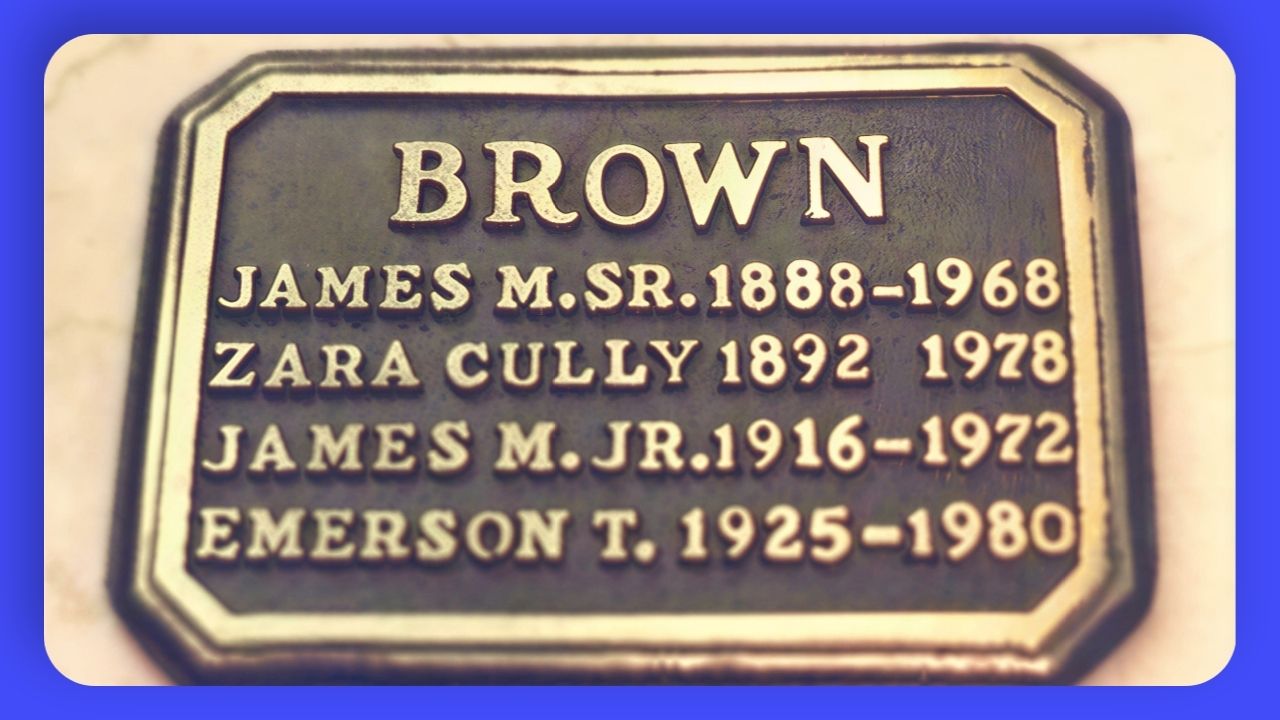

While millions of television fans adored Zara Cully as the sharp-tongued Mother Jefferson on The Jeffersons, few people know the name of the man who stood beside her for more than five decades. James M. Brown, Sr. lived a life largely away from the bright lights of Hollywood, yet his quiet devotion and family legacy form an essential chapter of American cultural history. Born in the late nineteenth century, he witnessed the dawn of the twentieth century, raised a family that would touch both entertainment and civil rights, and remained a steadfast partner through the sweeping changes of American society. Though he never sought fame, the story of James M. Brown, Sr. reveals the vital role that supportive partners and family patriarchs played in shaping the lives of public figures. His biography is more than a footnote to celebrity gossip—it is a window into the generational strength of an African American family that navigated the Jim Crow era, built community ties, and quietly influenced the nation.
James M. Brown, Sr. was an American family patriarch best known as the husband of Zara Cully, the actress who portrayed Mother Jefferson on The Jeffersons. He married Cully in 1914, raised four children with her, and remained her partner for 54 years until his death in 1968.
| Fact | Details |
|---|---|
| Full Name | James M. Brown, Sr. |
| Date of Birth | February 1, 1888 (disputed; some sources list 1886) |
| Age at Death | 80 years old |
| Birthplace | United States (exact city unknown) |
| Nationality | American |
| Profession | Private citizen; specific occupation unknown |
| Known For | Husband of Zara Cully; patriarch of the Brown family |
| Education | Unknown |
| Marital Status | Married to Zara Frances Cully (1914–1968) |
| Children | James M. Brown, Jr.; Mary Gale “Polly” Buggs; Emerson T. Brown; one infant daughter (deceased) |
| Residence | Reportedly Jacksonville, Florida |
| Net Worth | Unknown |
| Social Media | N/A |
The Early Life of James M. Brown, Sr.
Born in the late 1880s, likely February 1, 1888 (though some genealogical records suggest 1886), James M. Brown, Sr. entered the world during a period of intense racial and economic tension in the United States. His father was also named James M. Brown, and his mother was Janie Newbern, making him at least a second-generation bearer of the family name. Growing up in the American South during the Jim Crow period, he would have experienced strict racial segregation and limited economic opportunities that defined daily life for African Americans. The exact details of his childhood remain largely undocumented, which is common for working-class Black families of that era, whose stories were rarely recorded in mainstream historical archives. What we do know comes from genealogical research and family history preserved by descendants, painting a picture of a man born into a world where perseverance was not optional but essential.
The Brown family was part of a larger community of African Americans building lives in the South during a period of intense social and political upheaval. Following the Civil War and the collapse of Reconstruction, Black families like the Browns navigated a landscape shaped by sharecropping, emerging industrial work, and the Great Migration that would soon pull millions northward. While specific details about his siblings or extended family remain scarce, the naming convention suggests a strong sense of family continuity. His son, James M. Brown, Jr., and potentially a grandson named James M. Brown, III, continued this tradition, anchoring the family identity across multiple generations. This multi-generational naming is itself a form of legacy, signaling that James M. Brown, Sr. was rooted in a family that valued tradition and continuity in the face of societal adversity.
Education and Personal Life
Records regarding the formal education of James M. Brown, Sr. are not publicly available, a reality that reflects the limited educational access afforded to African Americans in the rural South during the late nineteenth and early twentieth centuries. Many schools for Black children were underfunded, overcrowded, or nonexistent in certain counties. If he did attend school, it likely ended well before high school, as was standard for the era. However, the absence of academic records does not imply a lack of intelligence or ambition. Personal accounts from family history blogs suggest that those who knew him referred to him as Daddy J, a nickname that implies affection and respect within a tight-knit family circle. Such informal titles often carry more weight than diplomas, revealing a man who was regarded as a teacher, protector, and moral compass in his own home.
His personal life was defined by deep commitment to family values. Long before his marriage to Zara Cully, he was establishing himself as a young man in a rapidly changing America. The 1910s marked a period when Black Americans were increasingly migrating from the South to Northern industrial cities, yet Brown chose to build his family in a different pattern. By the time he married in 1914, he had already demonstrated the qualities of stability and responsibility that would define his next fifty-four years. His personal philosophy, though not recorded in speeches or writings, can be inferred from the longevity of his marriage and the accomplishments of his children. A man who remains married for over five decades in an era of immense social upheaval is, by definition, a man of discipline, patience, and unwavering loyalty.
Career and Individual Achievements
Unlike his wife, James M. Brown, Sr. did not pursue a career in the public eye. He was a private citizen whose professional life remains largely undocumented in historical records. This is not unusual for African American men of his generation, whose labor whether in agriculture, skilled trades, or service industries—was often invisible to mainstream history. According to family genealogical sources, he may have lived and worked in or around Jacksonville, Florida, where the family later settled. Some reports suggest he may have worked in manual labor or trades, though no definitive occupational records have surfaced. His career, therefore, cannot be measured in awards or public recognition but rather in the stability he provided for his household. In an era when economic survival was a daily struggle for Black families, maintaining a steady income and a home was itself a profound achievement.
Where James M. Brown, Sr. truly distinguished himself was not in a professional title but in the intangible work of fatherhood and partnership. His greatest achievement may well be the fact that all of his surviving children reached adulthood during a period when infant mortality was high and economic hardship was pervasive. His son, James M. Brown, Jr., lived to be fifty-six. His daughter, Polly Buggs, lived to be eighty-eight and married into a position connected to the federal government. His son, Emerson T. Brown, also lived into adulthood. These outcomes suggest a household that was nurtured, protected, and guided. For a Black family in the early twentieth-century South, survival and upward mobility were achievements that required heroic levels of sacrifice and determination. In this context, Brown’s life represents the quiet heroism of millions of unnamed American workers and fathers.
James M. Brown, Sr. and His Relationship with Zara Cully
On August 24, 1914, in Worcester, Massachusetts, James M. Brown, Sr. married Zara Frances Cully, a woman who would later become one of television’s most recognizable Black actresses. The marriage took place during a pivotal era for African American culture, as the Harlem Renaissance was beginning to take shape and Black artistic expression was gaining new visibility. At the time of their wedding, Cully was already involved in theatrical work, though her fame would not arrive until decades later. Brown’s decision to marry a woman with creative ambitions speaks to his open-mindedness and support for her artistic pursuits. Many men of his era would have expected their wives to abandon public careers, yet Brown remained married to Cully for fifty-four years, through her transitions from stage work to radio to eventually landing the role of Mother Jefferson on The Jeffersons in 1975—seven years after his death.
The longevity of their union is particularly remarkable given the pressures faced by Black families in the twentieth century. From the Great Depression to the civil rights struggles of the 1950s and 1960s, they weathered economic hardship, racial discrimination, and personal loss together. They raised four children, though one infant daughter died in childbirth, a tragedy that must have deeply affected the family. Through it all, Brown remained the quiet anchor behind Cully’s public persona. While she performed on stage and screen, he provided the domestic stability that allowed her to pursue her craft. In many ways, their partnership exemplifies the unheralded contributions of spouses who enable artistic achievement. Zara Cully may have been the star, but James M. Brown, Sr. was the foundation upon which that stardom rested.
Net Worth and Lifestyle 2026
Because James M. Brown, Sr. passed away in 1968, long before the era of celebrity wealth tracking and internet financial disclosures, there are no reliable records of his net worth. His wife, Zara Cully, achieved modest financial success through her acting career, particularly in the final years of her life when she became a regular on a major network sitcom. However, that success came after Brown’s death. During their life together, the couple likely lived a working-class or middle-class lifestyle typical of African American families in the mid-twentieth century. Their residence in Jacksonville, Florida, suggests a life rooted in Southern Black community structures rather than the glitz of Hollywood or New York. There is no evidence of extravagant wealth, luxury homes, or significant property holdings.
In 2026, the concept of net worth is often applied retroactively to historical figures, but doing so for James M. Brown, Sr. would be misleading. His lifestyle was defined by family values, community ties, and long-term marriage rather than material accumulation. What he left behind was not a financial empire but a family legacy that included a connection to television history and, through his daughter, the civil rights establishment. Today, his descendants and extended family carry forward that legacy. In an age of viral celebrity and influencer culture, the modest, grounded life of James M. Brown, Sr. offers a reminder that historical significance is not always measured in dollars. His true wealth lay in the relationships he built and the generations he influenced.
Unique Facts and Lesser-Known Details
One of the most fascinating yet underreported aspects of the Brown family is its direct connection to the federal Civil Rights Commission. Mary Gale “Polly” Buggs, the daughter of James M. Brown, Sr. and Zara Cully, married John A. Buggs, who served as Deputy Director of the U.S. Civil Rights Commission from 1957 until 1975. This means that while Zara Cully was entertaining America on television, her own family was simultaneously helping to shape federal civil rights policy. This intersection of entertainment and activism within one family is extraordinarily rare and speaks to the breadth of influence the Brown-Cully lineage wielded. Most articles about Cully focus exclusively on her acting career, yet this civil rights connection reveals a family engaged at multiple levels of American public life.
Another lesser-known detail involves the complexity of the family name itself. Genealogical records on Find a Grave and WikiTree show conflicting birth years for James M. Brown, Sr.—some list 1886, others 1888. This discrepancy, while minor, illustrates the challenges of documenting African American genealogy during the Jim Crow era, when birth records were inconsistently kept. Additionally, the family nickname Daddy J, referenced in family history blogs, suggests a warmth and intimacy that formal records cannot capture. Perhaps the most poignant detail is that Brown died in 1968, the same year as the assassination of Dr. Martin Luther King Jr. and the passage of the Civil Rights Act of 1968 (Fair Housing Act). He died in a transformative year for Black America, just before his wife would achieve her greatest fame.
Frequently Asked Questions
Who was James M. Brown, Sr.?
James M. Brown, Sr. was the husband of actress Zara Cully, best known as Mother Jefferson on The Jeffersons. He was a family patriarch who married Cully in 1914 and remained her partner for 54 years until his death in 1968.
How long was James M. Brown, Sr. married to Zara Cully?
They were married for 54 years, from 1914 until his death in 1968. Their long marriage is a testament to their resilience during one of the most turbulent periods in American history.
Did James M. Brown, Sr. have children?
Yes. He and Zara Cully had four children, though one infant daughter died in childbirth. Their surviving children were James M. Brown, Jr., Emerson T. Brown, and Mary Gale “Polly” Buggs, who married a senior official at the U.S. Civil Rights Commission.
When did James M. Brown, Sr. die?
He died in 1968, reportedly in August of that year. This was the same year that the Civil Rights Act of 1968 was signed and Dr. Martin Luther King Jr. was assassinated.
What was James M. Brown, Sr.’s connection to the Civil Rights Movement?
While he was not a direct activist, his daughter Polly Buggs married John A. Buggs, who served as Deputy Director of the U.S. Civil Rights Commission. This family connection links the Brown household directly to federal civil rights policy during the 1950s and 1960s.
Conclusion
The life of James M. Brown, Sr. reminds us that history is built not only by famous names but by the quiet determination of ordinary individuals who create the conditions for extraordinary achievement. He was a husband, a father, and a patriarch who navigated the harshest realities of twentieth-century American life while supporting a wife whose talent would eventually reach millions. His marriage to Zara Cully lasted fifty-four years, a testament to mutual respect and shared resilience. Through his children, particularly Polly Buggs, his family legacy extended into the corridors of federal civil rights policy. Though he never appeared on screen or held public office, his influence rippled through the lives of those who did.
Today, when viewers revisit The Jeffersons and laugh at the wit of Mother Jefferson, they are also witnessing the indirect legacy of a man who made that career possible. James M. Brown, Sr. deserves recognition not as a celebrity spouse but as a representative of the countless Black men and women whose strength, sacrifice, and love enabled the cultural breakthroughs of the twentieth century. His biography is ultimately a story about family, endurance, and the quiet dignity of a life lived in service to others. In remembering him, we honor the unseen foundation of American entertainment and civil rights history.
Also Read: Who Is Virginia Grohl? All About Dave Grohl’s Mother
